Cohort training delivers added value to our graduates. QT is a broad and rapidly changing field and students in the CDT will be exposed to a much wider range of topics in dedicated courses compared to what could be achieved in a conventional single-university, single-supervisor programme. This learning experience will be amplified by student interactions across the cohort.
Training School
Cohort training delivers added value to our graduates. QT is a broad and rapidly changing field and students in the CDT will be exposed to a much wider range of topics in dedicated courses compared to what could be achieved in a conventional single-university, single-supervisor programme. This learning experience will be amplified by student interactions across the cohort.
The enhanced visibility and status of the CDT compared to individually funded studentships ensures that our graduates are recognised as having the knowledge and skills desired by future employers. A cohort will also be able to develop student-led networks and collaborations with industrial partners, building a community of future leaders of QT professionals.
The broad exposure and interactions across the cohort will be established in the first-year teaching programme and augmented by bringing together different cohorts for further skills development and the sharing of knowledge and ideas throughout the duration of the PhD training.
The cohort-based study programme will help break down existing barriers between physicists and engineers, and between theorists and experimentalists, to an extent that would be inconceivable in a traditional single-university, single-supervisor graduate programme.
Structure of the Training Programme
Year 1
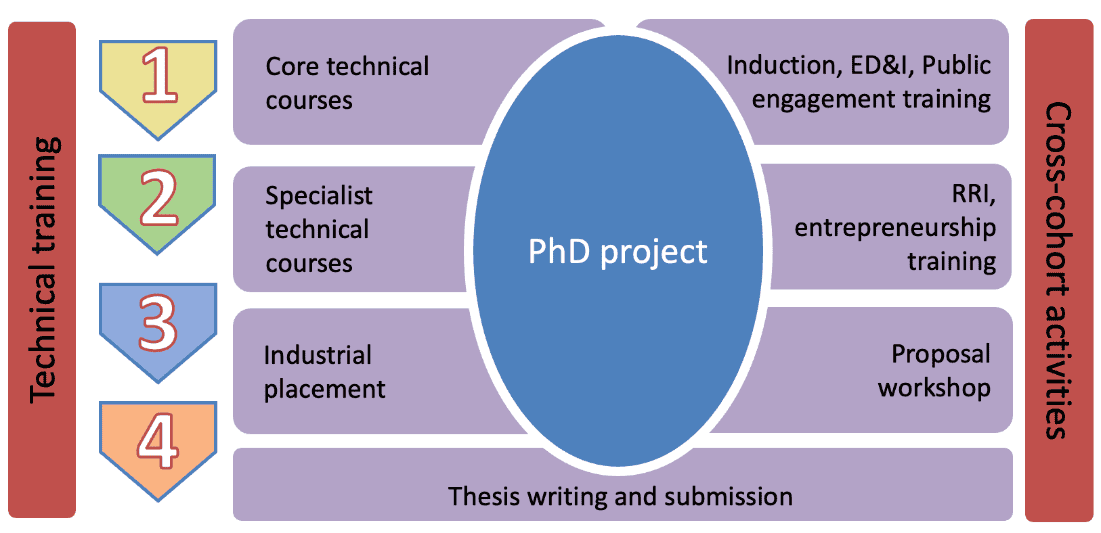
Students will start with an in-house and residential cross-cohort CDT Training School which serves as the kick-off event for each academic year, welcoming new students to the CDT.
The Training School will feature cross-cohort components, enabling new students to become quickly embedded in the CDT, and will focus on both scientific and personal development.
It provides an induction, foundational training in Concepts of Quantum Physics, and training in ED&I and Responsible Research and Innovation (RR&I).
Students will then commence their research projects, and in parallel will be taught in courses on the Physical Foundations of QT and Enabling Technologies.
Year 2
The year commences with the Training School where second year students will undertake soft-skills training workshops in subjects such as entrepreneurship, IP, mental health, and scientific writing. Guest lecturers from academia and industry will provide an annually updated seminar on advanced topics in QT.
The Training School also builds the starting point for outreach events, training students in engaging with the public in research topics and building of hands-on activities. Social events, culminating in an annual Ceilidh, will strengthen social bonds across all cohorts.
Second year students will start on a bespoke modular training programme in tandem with their PhD studies.
The interdisciplinary nature of QT, the expected diverse background of our students in physics, engineering, maths, computer science, and the range of topics covered by our supervisor pool allows us to offer modular training in adherence to best practice in postgraduate education.
Based on personal development plans created by each student, supported by their supervisors (academic and industry, if involved) and one of the CDT Co-Directors, they will choose a topical lecture course associated with one of the three broad QT areas, and the cross-cutting QT Discovery Lab training modules.
The QT Discovery Lab will provide students with the opportunity to undertake training modules in groups of 3-5, to develop practical experience, including hands-on lab work and numerical or computational training, as well as experience of self-led study and groupwork. Students are expected to spend approximately 60 hours working on the mini-project and they will have a semester to complete it, including documentation of results.
The training modules will give students access to equipment and expertise from across the range of CDT topics.
Examples are:
-
Rubidium Spectroscopy
Students use a laser, rubidium vapour cell and optics to explore atomic spectroscopy, two-photon excitation or optical pumping and develop a com-pact magnetometer
-
Photon Pair Source
Students use a pump laser, non-linear crystal, and photon counters to generate entangled photons and verify Bell-state preparation or Hong-Ou-Mandel interference, explore QKD protocols
-
Benchmarking and Verification
Students use QisKit implement algorithms for benchmarking and verifying performance of quantum hardware, with access to real experimental hardware via cloud-based providers.
Year 3 & 4
Year 3 and 4 students attend the Training School where they will participate in further skills training and will also participate in a proposal workshop, mirroring the acclaimed ‘Scottish crucible’ activity, where small student groups are guided through proposing a one-page research project relevant to their PhD research. They will also be encouraged to present their research to the other cohorts in a mini student via posters and presentations.
Year-3 and Year-4 students will increasingly focus on their main research project and activities suited to their individual future career paths. Depending on their personal training plan, they can complete industry placements with one of our partners, deepen their understanding by delving into further lecture topics, or complete appropriate topical third-party qualifications such as certification in quantum software, and prepare for thesis submission.
Cross-cohort events
In addition to the Training School, other cross-cohort events will take place including:
-
Industry Day
The Training School will culminate each year with an Industry Day, devoted to industry engagement and discussion panels led by the Industry Forum 2-day winter CDT Showcase. In addition, we will organise two Summer Schools with the International Scottish Universities Summer School in Physics (SUSSP) over the CDT lifetime.
-
CDT Showcase
The CDT Showcase will be a two-day non-residential event, showcasing the research projects and the work of industrial partners. Day One will see presentations from Year-4 students, highlighting their work to the CDT community, while Day Two will focus on industry, including keynote speakers and a half-day industry fair. The industry fair gives students opportunities to speak one-on-one with industry professionals working in QT, and allows industrial partners to advertise placements, intern-ships, and graduate positions. At all cohort events, time will be set aside for student-led activities, planned and prepared by the Student Council.
-
Summer Schools
We collaborate closely with the UK Quantum Technology Hubs to deliver specialist summer schools that provide our students with valuable opportunities to deepen their knowledge of quantum technologies, engage with leading researchers and industry experts, and develop practical skills in this rapidly growing field. These summer schools expose students to cutting-edge research, foster interdisciplinary collaboration, and help build professional networks that support future study and career development in the quantum sector.
-
SUPA Electives
In addition to the dedicated CDT core and elective courses, students will be able to personalise further via the extensive SUPA Graduate School course offer. Relevant courses include Gravitational Wave Detection, Quantum Field Theory, Modern Topics in Condensed Matter Physics, Electron Microscopy, Quantum Magnetism and Phase Transitions, Advanced Statistical Physics, Nanophotonics, Software Carpentry, FPGA Programming for Physicists, and more.